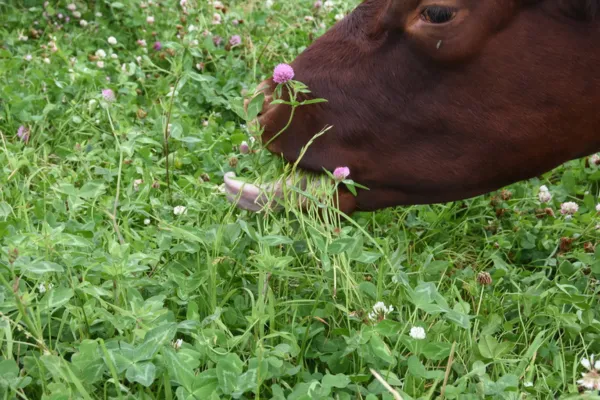
Why Grasses NEED to be grazed!
This report on Protecting and Utilizing Global Grazing Systems is worth reading
2026: A Global Focus on Rangelands
The UN has declared 2026 as the ‘Year of Rangelands and Pastoralists’. In time for the launch, the German farmer and MEP (Member of the European Parliament) Martin Häusling commissioned a 44-page grassland report. Before you roll your eyes and think 'not another report, skip to page 13 and the section written by veterinarian Anita Idel. Reading her six page section is worth your while. Promise.
The Overlooked Power of Grasslands
Idel has a long-standing interest in grasslands and grazing, following Allan Savory's work closely. While Savory focuses on how to manage cattle to benefit grass growth and soil health, Idel looks at why grasslands have such potential and why that fact is still so often overlooked.
Co-Evolution: Why Grazing Is Not Optional
Here are the main take-aways:
Grasslands co-evolved with cattle. Unlike other plants they don't just tolerate being grazed, they need to be grazed in order to thrive. "Grazing triggers a growth impulse in grasses: their photosynthetic capacity increases, they absorb more CO2 from the atmosphere and use it to produce more biomass and more humus", writes Idel.

The Biological Mechanism Behind the Claim
Plants like trees grow from shoots above ground. Once that shoot is nibbled off by a deer or a cow, growth there stops and that's why such plants invest a lot of energy in defence, such as growing thorns or bitter substances in their leaves. Grasses on the other hand grow from the bottom up - it's easy to observe: grasses can grow tall again after being grazed, but the ragged edges at the top of the blade are still visible. "Only if perennial grasses are not grazed (or mowed), they, too, like all other flowering plants transfer energy from the base upwards to form flowers. This energy is then no longer available for humus formation", writes Idel.
The Scientific Depth Behind Grass Physiology
For a deeper dive into grasses and their physiology the text references a whole host of literature, including the special 2022 ‘Science Magazine Special Issue Grass’.
Climate Strategy: Are We Looking in the Wrong Direction?
To combat climate change, tree planting is still considered to be the ideal solution, but grasslands are understudied and undervalued, says Idel. Not only can grasses grow where trees can't - at high altitudes for example or in arid conditions, grasslands can also sequester more carbon. Trees may have more total root mass but what counts is root quality. "Unlike in trees, the root biomass of grasses consists predominantly of fine roots. The main part of humus formation is based on root biomass. However, the specific type (quality) of the roots is crucial for humus formation: The humus building potential lies in the fine roots – which are characteristic of grasses".
Implications for Arable Farming
It's just one of the reasons why Idel advocates for integrating grazing animals into arable farming systems, too.
From Ecology to Policy
Based on the report, MEP Martin Häusling formulates a number of political demands, such as: "EU climate and biodiversity strategies should explicitly recognise well-managed grazing systems as key contributors to carbon sequestration, soil formation, water regulation, and biodiversity conservation. Permanent grasslands and rangelands must be protected from conversion and supported as climate-resilient ecosystems". Such a policy certainly wouldn't go amiss in the UK, either.
Rangelands as a Buffer Against Instability
If you have the time, do flip back to chapter one of the report which gives a global perspective and is the link to the aims of the UN year of Rangelands and Pastoralists. The authors argue that "when rangelands are protected and are sustainably managed through approaches that reflect both ecological dynamics and social realities they can serve as a buffer against the key pressure that drives conflict, food insecurity and forced displacement". Herders produce milk and meat, thus increasing food security. Combined with the environmental benefits, well managed rangeland gives a boost to the rural economy of a region, which means fewer people are forced to leave their villages and migrate to large cities or, in hope of a better life, to Europe. Maybe protecting rangelands and supporting herders in managing it well could be an interesting and very different approach to immigration policies.


