Weak Link — Strengthen the Right Part of the Chain
Building Holistic Thinking Muscle
Week 2: Weak Link
Progress is limited by the weakest link in any system. Week 2 explores the Weak Link check and how focusing effort in the right place strengthens the whole.
Once the problem is clear, the next question is where to act.
Last week we explored Cause & Effect — making sure we are solving the right problem.
This week we move to the second Context Check: Weak Link.
Once you know what problem you are trying to solve, the next question becomes:
Does this action strengthen the weakest link?
Because in any system — biological, social, or financial — progress is always limited by the weakest link. Strengthening anything else may look productive, but it rarely changes results.
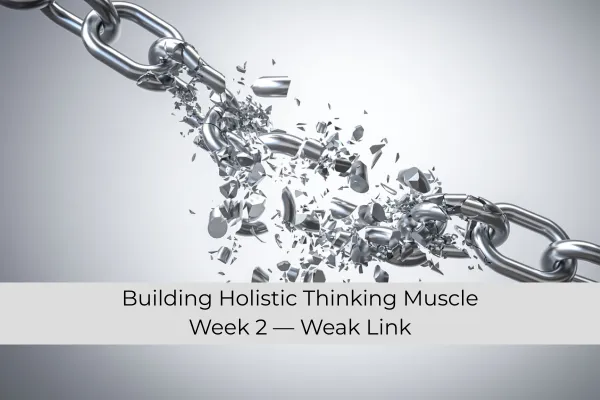
A chain is only as strong as its weakest link.
Think of a chain stretched between two points.
Its strength is not determined by the strongest links.
It is determined by the weakest one.
Strengthen every other link and the chain will still fail at exactly the same point.
Holistic Management applies this simple principle to decision-making.
Before investing time, money, or energy, we ask:
Does this action strengthen the weakest link?
If not, it may not move the system forward at all.
Weak links appear in three places: social, biological, and financial.
The Weak Link check appears simple, but it operates in three different domains:
• Social
• Biological
• Financial
Each one requires a slightly different kind of thinking.
Social weak links can stop good ideas from ever taking hold.
The social weak link concerns people.
Any plan relies on the support, understanding, or cooperation of others.
If a decision creates resistance among those whose support you need, that resistance becomes the weak link.
A technically brilliant idea can fail simply because people were not brought along.
The question we ask is:
Could this action create a weak link between us and the people whose support we need?
Sometimes the solution is not to change the plan — but to change how the plan is introduced.
Communication, inclusion, and timing often strengthen this link.
Biological weak links lie at the most vulnerable stage of a life cycle.
The biological weak link applies when we are dealing with living organisms.
Every organism has a point in its life cycle where it is most vulnerable.
If you want to increase or decrease a population — whether it is weeds, insects, livestock, or wildlife —
effectiveness comes from identifying that point.
For example, controlling a rush after it has already seeded may have little effect.
But interrupting it early in its life cycle through trampling with livestock can reduce future populations, and create the conditions for grasses and herbaceous plants.
The question becomes:
Does this action address the weakest point in the life cycle of the organism?
This approach often allows small actions to produce large results.
Financial weak links limit how resources turn into income.
The financial weak link applies to the chain of production that turns resources into income.
In simple terms, every enterprise has three stages:
1. Resource conversion
2. Product conversion
3. Marketing (money conversion)
If the weakest link sits in product quality, investing more in marketing will not solve the problem.
If the weakest link sits in marketing, improving production efficiency will not increase income.
The question we ask is:
Does this action strengthen the weakest link in the chain of production?
Until that link is strengthened, other investments cannot fully deliver results. It is like a clog in the drainpipe restricting the flow of value through the system.
Most wasted effort comes from working away from the weak link.
The Weak Link check protects us from a very common trap:
working hard on the wrong thing.
When people feel pressure, they often increase effort rather than change direction.
But effort applied away from the weak link rarely produces meaningful change.
Holistic thinking slows us down just enough to ask:
Where is the system actually constrained?
Once that is clear, effort becomes powerful.
Cause & Effect and Weak Link work together.
These checks build on each other.
First we check Cause & Effect.
Then we check Weak Link.
In other words:
Are we solving the right problem?
Are we strengthening the right part of the system?
Only when both are clear does the action begin to make sense.
Check your decisions this week by looking for the real constraint.
When checking a decision this week, ask yourself:
Where is the weak link?
Is this action strengthening it?
If not, am I better off investing resources elsewhere?
You may discover that the most effective change is not the most obvious one.
Next week: choosing the action that gives the best return.
Next week we explore Marginal Reaction.
Even when several actions pass the previous checks, resources are always limited.
Marginal Reaction helps answer the question:
Which action gives the greatest return for each additional unit of time, money, or effort?

