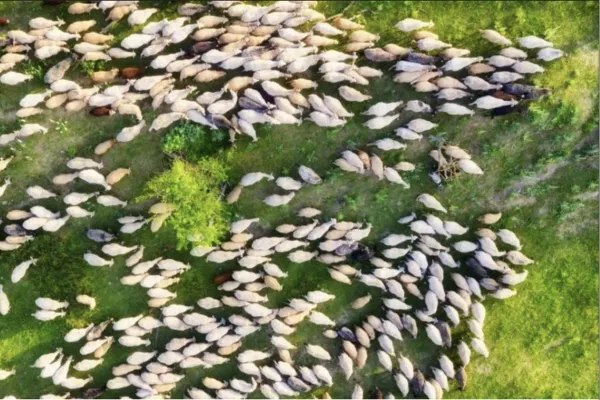
Grasslands Need Grazing — But Europe Has Lost 70% of Its Grazing Farms
A hidden report turns out to be a treasure trove of grassland data
Admittedly, if it hadn’t been for a tip-off I would not have found Analytical Brief No. 13, titled, “Grassland and livestock dynamics: How grazing management sustains and shapes European grasslands.”
The report turns out to be a real treasure trove of data on grasslands, measures that help preserve them or prevent further decline, and data sets for each of the EU Member States.
The country-specific information is particularly interesting because it shows the differences between northern European countries with sufficient rainfall and drought-prone southern Europe.
The good news:
“About one-third of EU farmland is grassland (calculated based on utilised agricultural areas): roughly 51 million ha of permanent grassland and 7 million ha of temporary grassland. Before 2000, the permanent grassland area was declining, while more recent data indicate an overall stability of EU grassland area with minor fluctuations across EU countries in the last 20 years.”
Policy matters — and definitions shape what farmers do
The figures show the impact of agricultural and environmental subsidy programmes under CAP, the EU’s Common Agricultural Policy.
CAP provides only a framework — it is up to Member States to specify conditions and allocate the money.
“Definitions matter for policy: under the current CAP, land kept in grass for over five years gains protected status, i.e. it becomes permanent grassland. However, since 2018 Member States can allow ploughing, tilling and reseeding without changing the ‘arable land’ classification. Depending on Member State choices, farmers can be influenced by these rules.”
A farm is a business, and it often makes little financial sense to keep permanent grassland if more money can be made from arable crops.
Grasslands face two opposite threats: abandonment and intensification
The Commission report identifies abandonment and intensification as the two main threats to grasslands.
In less productive or remote areas, many extensively managed pastures and meadows are at risk of abandonment because extensive livestock farming is barely profitable. This trend is particularly visible in mountain regions of southern Europe.
When traditional grazing or mowing stops, grasslands quickly turn into shrubland or woodland. That leads to declines in open-habitat species, changes in soil carbon storage, and increased wildfire risk.
Studies consistently show that when grazing stops, plant diversity declines — a clear sign that active management is essential to sustain grassland quality and ecological value.
In more productive areas the opposite trend occurs. Farmers may plough older pastures to grow arable crops or high-yield silage leys, especially when markets or policies make arable production more attractive.
Fewer livestock farms means fewer animals managing grassland
Grassland needs to be grazed, but the number of livestock farms that traditionally grazed animals or relied on hay and silage decreased between 2010 and 2020 across Europe by a staggering 70%.
The remaining farms have 40% fewer animals, and the permanent grassland area they manage fell by 35%.
Many small, extensive farms exited the sector, particularly in mountain regions and small dairy or sheep systems. Low profitability, labour shortages and lack of succession are major factors.
At the same time, intensive dairy and beef operations have grown larger. Animals are concentrated on fewer holdings, with less land per head and increasing reliance on imported feed.
Sustainable grazing improves soils, biodiversity and climate resilience
The report details the consequences of both overgrazing and undergrazing: soil erosion, loss of biodiversity, loss of wildlife, and increased fire risk — particularly in drought-prone regions.
But it also highlights the benefits of well-managed grazing.
“Grasslands with well-planned periodic and rotational grazing tend to store carbon effectively, especially when compared to ploughed croplands.”
Grasslands act as long-term carbon sinks because carbon accumulates in roots and soil over decades.
Compared to forests, grasslands store carbon differently but often more securely, as they are less vulnerable to catastrophic disturbances such as fire.
Research suggests that improved grazing practices could offset about 12% of past soil carbon loss.
Grasslands need management — and that management costs money
Mowing grasslands is not as effective as well-managed grazing. However, more frequent mowing that mimics grazing disturbance can increase biodiversity and is preferable to abandonment.
There are also notable gains in ecosystem services when degraded grasslands are restored through reseeding and the reintroduction of livestock.
The report’s conclusions are clear:
Grassland-based livestock systems can deliver climate benefits, biodiversity protection and vibrant rural landscapes — while producing high-quality animal protein on land where other agriculture is often not possible.
But these benefits do not come for free.
Grasslands must be sustainably managed, and what counts as sustainable varies by region and rainfall.
And sustainable grassland management requires people.
As the report puts it:
“Human labour is essential for managing the balance between land and livestock in a sustainable manner.”
That labour has a cost.
Which means ecosystem services need to be financially rewarded — just as grass-fed beef and lamb should be valued for the environmental benefits that grazing animals provide.
Hopefully DEFRA gets a tip-off and a link to Analytical Brief No. 13 before the criteria for the SFI scheme are finalised.


